Loading...
Back to Unit

Linear programming

Unit: Quantitative Analysis

Premium Topic Resources

Sign in to download the full Topic PDF and enable offline revision mode.

Login to Access
Join the community! 550+ students upgraded in the last 24 hours. Limited Discount Seats Available

August 2025

1 Questions
Question 7a
​ ​ ​​Jojox Steel Limited manufactures black and white sheets of steel. A black sheet requires 12 minutes for moulding, 24 minutes for galvanizing, 18 minutes for rolling and 27 minutes for packaging. A white sheet requires 8 minutes for moulding, 6 minutes for galvanizing, 12 minutes for rolling and 60 minutes for packaging. The firm’s management monitors the production process times as it has a maximum of 126 hours for moulding, 120 hours for galvanizing, 142 hours for rolling and 540 hours for packaging. The selling price per sheet is Sh.4,000 for the black sheet and Sh.3,300 for the white sheet. 
 
Required: 
(i) Formulate the linear programming model to represent the above information. 
 
(ii) Using the graphical method, solve the linear programming model formulated in (a) (i) above. 


Answers and Explanations are locked.

Login to View Answer

April 2025

1 Questions
Question 7b
​ ​​A company owns two flour mills; A and B which have different production capabilities for high, medium and low grade flour.  The company has entered into a contract to supply flour to a firm every week with 120, 80 and 240 kilograms of high, medium and low grades flour respectively.  It costs the company Sh.10,000 and Sh.8,000 per day to run Mill A and Mill B respectively.  On a daily basis, Mill A produces 60, 20 and 40 kilograms of high, medium and low grade flour respectively while Mill B produces 20, 20 and 120 kilograms of high, medium and low grade flour respectively.  
 
Required: 
(i) Formulate the above problem as a linear programming problem in order to minimise the total cost of operation.
 
(ii) Graphically determine the number of days per week that each mill should operate to minimise the total cost of operation. 


Answers and Explanations are locked.

Login to View Answer

December 2024

2 Questions
Question 6b
​ ​ ​​A factory produces two products; product A and product B. The company wants to determine how many units of each product to produce in order to maximise profit. The production of each product is subject to two resource constraints; machine hours and labour hours. 

 The profit for each unit of product A is Sh.40 and Sh.30 for product B. 

 Each unit of product A requires 2 hours of machine time, while each unit of product B requires 1 hour of machine time. The company has a maximum of 100 machine hours available. 

 Each unit of product A requires 1 hour of labour and each unit of product B requires 2 hours of labour. The company has a maximum of 80 labour hours available.

Required: 

(i) Formulate the above problem as a linear programming problem. 

(ii) Determine the optimal solution using the simplex method. 


Answers and Explanations are locked.

Login to View Answer
Question 4a
​​Enumerate FOUR assumptions of linear programming model.


Answers and Explanations are locked.

Login to View Answer

August 2024

1 Questions
Question 4b
​ ​ ​​Bobino Electricals Limited manufactures electric kettle and electric cookers. 

Each electric kettle is sold at Sh.1,950 and each electric cooker is sold at Sh.2,400.

An electric kettle requires 3 kilograms of steel while an electronic cooker requires 5 kilograms of steel. Steel costs Sh.200 per kilogramme. It costs the company Sh.120 per hour to assemble each of the products. It takes 5 hours to assemble an electric kettle and 7 hours to assemble an electronic cooker. 

There are 1,500 kilograms of steel available and a total of 2,450 hours available for assembling. 

Required: 

(i) Formulate the linear programming equations necessary to solve the above problem. 

(ii) Solve the linear programming equations formulated in (b) (i) above graphically. 


Answers and Explanations are locked.

Login to View Answer

April 2024

1 Questions
Question 5b
​ ​ ​​World K Tours has Sh.6 million that may be used to purchase new rental minibuses for hire during the coming holidays. The minibuses may be purchased from two different manufacturers. 

Important data concerning the minibuses is summarised below:

Minibus type 
Manufacturer
Cost
Maximum seating
Expected daily profit
capacity
per minibus (Sh.)
Weaverbird
Fastbus
80,000
11
10,000
Eaglet
Fastbus
90,000
14
12,000
Dovey
Smartbus
70,000
7
  9,000
Crowlet
Smartbus
140,000
18
16,000

World K Tours wishes to purchase at least 80 minibuses and equal numbers from each of the manufacturer. World K Tours wishes to have a total sitting capacity of at least 500. 

Required: 

(i) Formulate the above linear programming problem.

(ii) Outline FOUR assumptions of the linear programming technique.


Answers and Explanations are locked.

Login to View Answer

December 2023

1 Questions
Question 7b
​ ​ ​ ​ ​ ​ ​​A manufacturer of dresses makes two types of dresses; Standard and Executive. Each Standard dress requires 10 labour hours from the cutting department and 30 labour hours from the sewing department. Each Executive dress requires 20 labour hours from the cutting department and 40 labour hours from the sewing department. The maximum labour hours available in the cutting department and the sewing department are 320 and 540 respectively. The company makes a profit of Sh.500 on each Standard dress and Sh.800 on each Executive dress. 

Required: 

(i) Formulate a mathematical model for the above linear programming problem. 

(ii) Using the simplex method, determine the number of Standard and Executive dresses that should be produced in order to maximise profit.


Answers and Explanations are locked.

Login to View Answer

August 2023

1 Questions
Question 3b
​ ​ ​​A firm manufactures two models of bicycles; mountain bike and BMX. The firm earns profit of Sh.5,000 and Sh.6,000 on mountain bikes and BMX respectively. Both models are produced in three departments; assembly, fitting and painting. The time required per model produced and the time available per week (in hours) are given in the table below:

Departments
Required time 
Available time

Mountain bike
BMX

Assembly
2
3
180
Fitting
2
1
120
Painting
3
3
240

Required: 

(i) Formulate the above problem as a linear programming problem in order to maximise profits.

(ii) Graphically show how the manufacturer should schedule his production to maximise profits.

(iii) Compute and interpret the slack value for the painting department.


Answers and Explanations are locked.

Login to View Answer

April 2023

1 Questions
Question 7b
​ ​ ​ ​ ​​A linear programming problem has been formulated as below:
Objective function: Max Z = 14x + 10y

Subject to:
1. 4x + 3y ≤ 240
2. 2x + y ≤ 100
3. y ≤ 50
4. x, y > 0
 
Required:

(i) Optimal production for x and y using the simplex method. 

(ii) The slack values for each constraint. 

(iii) The shadow price for each constraint.


Answers and Explanations are locked.

Login to View Answer

December 2022

1 Questions
Question 7c
​ ​​Majux Limited manufactures two types of fruit juices; yellow juice and red juice. 1 packet of yellow juice requires 3 minutes for cutting of fruits, 6 minutes for blending, 7 minutes for cooling and 2 minutes for packaging. 1 packet of red juice requires 5 minutes for cutting of fruits, 4 minutes for blending, 10 minutes for cooling and 5 minutes for packaging. 

The company’s workforce can only spend a maximum of 60 hours on cutting, ​\(\displaystyle 71 \frac{1}{3}\)​ hours on blending, 105 hours on cooling and 45 hours on packaging. The profit contribution is Sh.450 for each packet of yellow juice and Sh.380 for each packet of red juice.

Required: 

(i) Formulate a linear programming model from the above information. 

(ii) Use the graphical method to solve the linear programming model formulated in (c) (i) above. 

(iii) Calculate the slack or surplus values for cutting of fruits and interpret its meaning


Answers and Explanations are locked.

Login to View Answer

August 2022

2 Questions
Question 2a
​​TMA Company produces three products; Standard, Deluxe and Luxury in three of its departments which are Cutting, Assembly and Finishing. The total available labour hours per week for Cutting, Assembly and Finishing departments are 180, 300 and 240 respectively.

To produce two units of Standard requires 240 minutes in the Cutting department, half the amount of time in the Assembly department and same amount of time in the Finishing department as in the Cutting department.

To produce one unit of Deluxe requires 60 minutes, 180 minutes and 60 minutes in Cutting, Assembly and Finishing departments respectively.

To produce three units of Luxury requires 180 minutes in Cutting department and twice the amount of time in both Assembly and Finishing departments.

The contribution per unit from Standard, Deluxe and Luxury is Sh.6, Sh.5 and Sh.2 per unit respectively.

Required:

(i) Formulate the above problem as a linear programming model.

(ii) Prepare an initial simplex tableau to solve the above model.


Answers and Explanations are locked.

Login to View Answer
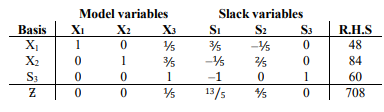
Question 2b
​ ​ ​​
The above problem was solved using a statistical software and the final simplex tableau is provided below:

Inserted Image
Required: 

(i) Explain whether the solution is optimal. Justify your answer. 

(ii) Determine the optimal solution for TMA Company. 

(iii) Determine the slack or surplus value for each constraint. State which one is a slack and which one is a surplus. 

(iv) Determine the shadow price for each constraint


Answers and Explanations are locked.

Login to View Answer

April 2022

2 Questions
Question 6a(i)
​​Highlight four requirements that must be met before the linear programming model can be applied.


Answers and Explanations are locked.

Login to View Answer
Question 6a(ii)
​ ​​A company makes two products; 1 and 2. 

Each product requires time on two machines A and B. The specifications for each product are as follows:

Product 1
Product 2
Processing time:


  • Machine A (Hours/unit)
1.6
1.0
  • Machine B (Hours/unit)
2.5
1.0

Selling price (Sh./unit)

22

48
Material and labour cost (Sh./unit)
14
37
Maximum possible production and sale (units)
30
50
Maximum time available for machine A is 80 hours and for machine B is 100 hours.

Required: 

Formulate a linear programming model to determine the number of product 1 and product 2 which should be produced and sold in order to maximise total contribution for the company using the graphical method.


Answers and Explanations are locked.

Login to View Answer
Question 6a
​ ​ ​Write short notes on the following formulas in relation to time series analysis: 

(i) Y = T x C x S x I 

(ii) ​\(Y_T = b_o + b_{Ix}\)

(iii) ​\(ln Y_T = ln b_o + ln b_I\)​ 

(iv) ​\(bI ={\large \frac{\sum{xy} – n\bar{X}\bar{Y}}{ \sum{x^2} – n\bar{X}^2}}\)


Answers and Explanations are locked.

Login to View Answer
Question 6b
​​Explain the process of exponential smoothing.


Answers and Explanations are locked.

Login to View Answer
Question 7
​​In the context of linear programming, explain each of the following: 

(a) Constrained optimisation. 

 (b) Inequality constraints. 

 (c) Objective function. 

 (d) Constrained minimisation. 

 (e) Non-negativity constraints.


Answers and Explanations are locked.

Login to View Answer

December 2021

3 Questions
Question 5
​ ​ ​ ​​Bantu Limited makes two types of pudding: vanilla and chocolate. Each serving of vanilla pudding requires 2 teaspoons of sugar and 25 fluid measures of water, and each serving of chocolate pudding requires 3 teaspoons of sugar and 15 fluid measures of water. Bantu Limited has available each day 3,600 teaspoons of sugar and 22,500 fluid measures of water. Bantu Limited makes no more than 600 servings of vanilla pudding because that is all that it can sell each day. Bantu Limited makes a profit of Sh.10 on each serving of vanilla pudding and Sh.7 on each serving of chocolate pudding. 

Required: 

(a) Formulate a linear programming model to solve the above problem. 

(b) Construct an initial simplex tableau. 

(c) Using the simplex method, determine how many servings of each type of pudding Bantu Limited should make in order to maximise profit.


Answers and Explanations are locked.

Login to View Answer
Question 3b
​ ​​The marketing department of Jacuzi Ltd. estimates the daily demand function of one of its products to be linear in nature. If the price was fixed at Sh.570, the daily demand would be 400 units. If the price was increased to Sh.820, the daily sales would drop to 200 units. 

The production department has indicated that the marginal cost of producing Q units of the product is given by the following equation:

MC = 2Q - 570 

Where: MC is the marginal cost and 
            Q is the number of units produced. 

The daily fixed cost is Sh.1,100. 

Required: 

(i) The revenue function of Jacuzi Ltd. 

(ii) The total cost function of Jacuzi Ltd. 

(iii) The maximum profit that Jacuzi Ltd. could make.


Answers and Explanations are locked.

Login to View Answer
Question 3a
​​Explain the following terms as used in Markov analysis: 

(i) Markov process. 

(ii) Equilibrium state. 

(iii) Absorbing state. 

(iv) Closed state.


Answers and Explanations are locked.

Login to View Answer

September 2021

1 Questions
Question 2b
​ ​ ​ ​ ​ ​ ​​Zakem Ltd. produces two products namely; "Alkon" and "Zenon". The products pass through three departments namely; Assembly, Finishing and Packaging. There is a maximum of 200 hours in each of the Assembly and Finishing departments. 

In addition, a maximum of 400 hours of packaging are available for packing "Alkon" and "Zenon". 

The table below shows the number of hours required per unit of each product:

Hours required per unit of product
Department
"Alkon"
"Zenon"
Assembly
2
3
Finishing
4
2
Packaging
5
3

Each unit of "Alkon" and "Zenon" gives a profit contribution of Sh.3,000 and Sh.2,000 respectively. 

Required: 
(i) Formulate a linear programming model to solve the above problem. 

(ii) Using the simplex method, solve the linear programming model formulated in (b) (i) above.


Answers and Explanations are locked.

Login to View Answer

May 2021

1 Questions
Question 3b
​ ​ ​​Kazi na Bidii Ltd. sells four types of products. The resources needed to produce one unit of each product and thie sales prices are given as follows: 

Cost and resources requirements for Kazi na Bidii Ltd.

Resource
Product 1
Product 2
Product 3
Product 4
Raw materials (units)
2
3
4
7
Labour hours
3
4
5
6
Sales price (Sh.)
4
6
7
8

Additional information: 
  1. Currently, 4,600 urfits of raw materials and 5,000 labour hours are available. 
  2. To meet customers' demand, exactly 950 total units must be produced and at least 400 units of Product 4 must be produced. 
  3. A computer output ofthe above linear programming model has been given as follows:
MAX 4x + 6.5x2 + 7x3 + 8x4

SUBJECT TO: 
   2) x₁ + x2 + x3 +x4 = 950
   3) x4 > = 400 
   4) 2x +3x2 + 4x3 + 7x4 < = 4600 
   5) 3x+ 4x2 + 5x3 + 6x4 < = 5000 
END
LP OPTIMUM FOUND AT STEP 4

ОBJЕCТIVE FUNCTION VALUE
1) 6650.0000
VARIABLE
VALUE
REDUCED COST
X1
X2
X3
X4
.000000
400.000000
150.000000
400.000000
1.000000
.000000
.000000
.000000
ROW
SLACK OR SURPLUS
DUAL PRICES
2)
3)
4)
5)
0.000000
0.000000
0.000000
250.000000
3.000000
-2.000000
1.000000
.000000
NO. ITERATIONS 4

RANGES IN WHICH BASIS IS UNCHANGED
            ОВJЕСTIVE COEFFICIENT RANGES
VARIABLE
CURRENT COEFF
ALLOWABLE INCREASE
ALLOWABLE DECREASE 
X1
4.000000
1.000000
Infinity 
X2
6.000000
0.66667
.500000
X3
7.000000
1.000000
.500000
X4
8.000000
2.000000
Infinity

RIGHT-HAND SIDE RANGES
            ОВJЕСTIVE COEFFICIENT RANGES
VARIABLE
CURRENT RHS
ALLOWABLE INCREASE
ALLOWABLE DECREASE 
2)
950.000000
50.000000
100.000000
3)
400.000000
37.000000
125.000000
4)
4600.000000
250.000000
150.000000
5)
5000.000000
Infinity
250.000000

Required: 

(i) The optimal solution to the problem. 

(ii) The optimal solution if the company raises the price of product 2 by Sh.0.50 per unit. 

(iii) The optimal Z-value if a total of 980 units must be produced. 

(iv) The optimal Z-values where 4,500 units and 4,400 units of raw materials are available.


Answers and Explanations are locked.

Login to View Answer

November 2020

2 Questions
Question 4a
​ ​​Explain the following terms as used in linear programming:

(i).   Infeasibility.
(ii).  Unboundedness.


Answers and Explanations are locked.

Login to View Answer
Question 4b
​ ​ ​ ​ ​​A training institution has four lecturers represented as L1, L2, L3 and L4. The Head of department wishes to assign them to handle three topics in quantitative analysis; T1, T2 and T3. This will be done based on competency which is measured in terms of mastery of subject matter and personal preference on the time schedule while satisfying policies and provisions of the institution.

All of the lecturers have taught the topics in the past and have been evaluated with the following scores in the three different topics as follows:

          Topics
T1
T2
T3
Lecturers
L1
L2
L3
L4
42
48
50
58
16
40
18
38
27
25
36
60

Required:
(i).   The optimal assignment for these three topics,
(ii).  The maximum score.
(iii). The lecturer that will not be assigned any topic.


Answers and Explanations are locked.

Login to View Answer

November 2019

1 Questions
Question 5b
​​A manufacturing firm produces two products, X and Y. The standard revenues and costs per unit of the products are as follows:

   Product
XY
Sh.
Sh.
Sh.
Sh.
Selling price
400
360
Variable costs:


      Material B (Sh.20 per kg)
80
80
      Direct labour (Sh.16 per hour)
64
32
      Packing (Sh.24 per hour)
24

48

      Other variables
152
(320)
140
(300)
Fixed overhead (Sh.14 per hour direct labour)
(56)
(28)
Standard profit
24
32

Additional information: 

1. Packaging is a separate automated task and the cost relates to materials and electricity. 
2. The maximum available inputs per week are limited as follows: 

   Material В                 240 kg 
   Direct labour             200 hours 
   Packaging time        100 hours 

3. The profit ofthe company could be increased by increasing the selling price of product Y. 

Required: 
(i) Formulate and solve the above Linear programming model graphically. 
(ii) Determine the maximum selling price of Product Y at which the solution in (b) (i) above would still remain optimal.


Answers and Explanations are locked.

Login to View Answer

May 2019

2 Questions
Question 4a
​​ Highlight two differences between "transportation" and "assignment" models of linear programming.


Answers and Explanations are locked.

Login to View Answer
Question 4b
​​ Summarise three applications of shadow prices in decision making.


Answers and Explanations are locked.

Login to View Answer

November 2018

1 Questions
Question 1b
​​Outline three assumptions of the transportation model.


Answers and Explanations are locked.

Login to View Answer

May 2018

2 Questions
Question 4c
​ ​​A firm manufactures two products, X and Y, subject to constraints on three raw materials, RM1, RM2 and RM3. The objective of the firm is to select a product mix that will maximise weekly profit. Each unit of product X earns a profit of Sh.2 whereas each unit of product Y earns a profit of Sh.1.

Details of the raw materials required for the production of products X and Y are as given below:

Raw material
Maximum quantity
Quantity required per unit of production
(units)
Product X
Product Y
RM1
27
3
0
RM2
30
0
2
RM3
20
1
1

Required:
(i)  A linear programming model of the firm. 
(ii) The optimum product mix using the simplex method.


Answers and Explanations are locked.

Login to View Answer
Question 1a
Enumerate four assumptions that are implied in the application of the linear programming model.​​


Answers and Explanations are locked.

Login to View Answer

May 2017

1 Questions
Question 3b
​​Green Furniture Limited manufactures two models of plastic chairs, ​\(C_1\)​and ​\(C_2\)​ from plastic waste, using two automated machines, X and Y. The following information relates to the production of the two models of chairs for the coming year:

\(C_1\)
\(C_2\)
Maximum sales (units)
8,00012,000
Selling price (Sh.)
1,000900
Machine time (hours):
X
0.50.3
Y
0.40.45

The maximum operating hours of machines X and Y are 3,400 and 3,840 respectively. The maximum quantity of plastic waste available is 34,000 kilogrammes and each chair requires 4 kilogrammes of plastic waste. The company purchases plastic waste at Sh.50 per kilogramme. Variable machine overheads are estimated to be Sh.250 and Sh.300 per machine hour for machines X and Y respectively. All chairs produced are expected to be sold during the period. A computer generated print out of the linear programming model is as given below:

Objective function value 4,441,250.

Variable
Value
Reduced
Values
Objective
coefficient
All increase
All decrease
\(C_1\)
4,250
0
555
261.70
65.00
\(C_2\)
4,250
0
490
65.00
157.00
Constraints
Value
Shadow
Price
Right hand
side constraint
Allowable
increase
Allowable
decrease
Plastic waste
34,000
98,125
34,000
1,733.33
6,800
Machine X
3,400
325,000
3,400
850
850
Machine Y
3,612.5
0
3,800
-
227.5

Required: 
(i) Formulate the mathematical model for the linear programming problem.
(ii) The maximum contribution of ​\(C_1\)​ and ​\(C_2\)
(iii) Explain the effect on contribution of the availability of additional plastic waste and machine time.
(iv) Explain the sensitivity of the model to changes in contribution per unit of ​\(C_1\)​ and ​\(C_2\).
(v) The increase in contribution of Green Furniture Limited assuming that the management overcomes the plastic waste constraint.


Answers and Explanations are locked.

Login to View Answer

November 2016

3 Questions
Question 1a
​​Explanation of the following terms as used in Linear programming

(i) Infeasibility.
(ii) Unboundedness.
(iii) Alternate optimality.


Answers and Explanations are locked.

Login to View Answer
Question 3a
​ ​​TOC Limited, an oil prospecting company, intends to set up two oil refineries, refinery I and refinery II.

The following information relates to TOC Limited:
1. The company will produce two types of fuel; diesel and petrol, in each of the two refineries.
2. Three types of resources namely; crude oil, furnace time and mixer will be required to produce each litre of fuel.
3. The resource requirements for each of the two refineries is as follows:  

Fuel per litre
Crude oil
(litres)
Furnace time
(hours)
Mixer
(litres)
Diesel (Refinery I)
3
2
8
Petrol (Refinery I)
1
1
6
Diesel (Refinery II)
3
1
7
Petrol (Refinery II)
2
1
5

4. The daily amount of crude oil available at the two refineries are 12,000 litres and 15,000 litres for refinery I and refinery II respectively.
5. The hours of furnace time available at the two refineries are 10 hours and 4 hours for refinery I and refinery II respectively.
6. The total amount of mixer available for use at the two refineries is 80,000 litres per day.
7. The fuel is expected to be sold at Sh.170 per litre of diesel and Sh. 160 per litre of petrol.
8. All fuel produced is expected to be sold to a sole distributor. It will cost Sh.80 to transport each litre of fuel from refinery I and Sh. 100 from refinery II to the sole distributor.
9. Assume that crude oil cannot be transported from one refinery to another.

Required:
Formulate a linear programming model to maximise TOC Limited's revenue, assuming that only transport cost is variable.


Answers and Explanations are locked.

Login to View Answer
Question 4a
​​Enumerate four limitations of linear programming models.


Answers and Explanations are locked.

Login to View Answer

May 2016

1 Questions
Question 4b
​​ Farm Produce Limited is a producer and distributor of maize flour. The company owns milling plants in Eldoret, Nanyuki and Narok towns. The milling plants have not been able to meet the demand orders of the company’s distribution offices located in Mombasa, Kisumu, Nairobi and Isiolo towns. The company is considering the construction of a new milling plant either in Nakuru town or Meru town, in order to expand its production capacity. The data below relate to the company’s production and demand requirements.

Milling plant

Eldoret
Nanyuki
Narok
Monthly
output (units)

30,000
12,000
28,000
Unit production
cost (Sh.)

96
100
104

Distribution office
Mombasa
Kisumu
Nairobi
Isiolo
Monthly demand (units)
20,000
24,000
30,000
18,000

Additional information:

  1. The estimated unit production costs in Nakuru and Meru towns are Sh.98 and Sh.106 respectively.
  2. The unit transportation costs (in shillings) from each milling plant to each distribution office are given as follows

    To
    From
    Eldoret
    Nanyuki
    Narok
    Mombasa
    64
    56
    58
    Kisumu
    36
    52
    42
    Nairobi
    52
    44
    36
    Isiolo
    58
    32
    50

  3. The estimated unit transportation costs (in shillings) from each of the proposed milling plants to each distribution office are as follows:

    To
    From
    Nakuru
    Meru
    Mombasa
    60
    62
    Kisumu
    46
    56
    Nairobi
    40
    46
    Isiolo
    52
    28
  4. Assume that the construction of one of the proposed milling plants would satisfy the demand deficiency

Required: 
Using the Vogel's approximation method (VAM), advise the management of Farm Produce Limited on the best location to construct the milling plant.


Answers and Explanations are locked.

Login to View Answer

November 2015

1 Questions
Question 4b
​​Highlight four applications of linear programming in business.


Answers and Explanations are locked.

Login to View Answer
Question 3a
​​Lanex Company specialises in the production of an industrial dye. The firm manufacturers two types of dyes; light and dark. The selling price and the unit variable costs for the dyes are shown below:


Production
Light
Dark
Selling price
(Sh.) per litre

13.00
16.00
Unit variable cost
(Sh.) per litre

9.00
10.00

Each litre of light dye requires 6 minutes of skilled labour and each litre of dark dye requires 12 minutes of skilled labour.

In a given day, there are 400 man hours of skilled labour available. There are also 100 grammes of an important blending chemical available each day, where each litre of light dye requires 0.05 grammes of the blending chemical and each litre of dark dye requires 0.02 grammes of the chemical

The processing capacity at the plant is limited to 3,000 litres of dye per day.

The company is committed to supply a leading retailer with 5.000 litres of light dye and 2,500 litres of dark dye each working week (consisting of five days). In addition, there is an agreement with the unions that at least 2,000 litres should be produced each day.

Lanex company's management would like to determine the daily production volume for each of the two dyes that will maximise total contribution.

Required:
(i) A linear programming model of the production problem facing Lanex company.
(ii) Using the graphical approach, determine the optimum daily production plan and consequent contribution


Answers and Explanations are locked.

Login to View Answer