Mathematical Techniques - Matrix Algebra
Unit: Quantitative Analysis
Premium Topic Resources
Sign in to download the full Topic PDF and enable offline revision mode.
Login to AccessPractice CPA Quantitative Analysis Mathematical Techniques - Matrix Algebra questions with detailed answers and explanations.
Access past exam questions by topic, improve your understanding, and download PDF for offline revision.
April 2026
1 Questions| \(A = \begin{pmatrix} 4 & 2 \\ 1 & 3 \end{pmatrix} , B = \begin{pmatrix} 2 & 1 \\ 5 & 2 \end{pmatrix}\) |
December 2025
1 Questions
The following details were provided by the suppliers:
1. Production of each door requires 2 hours in welding department, 7 hours in the painting department and 5 hours in the drying department.
2. Production of windows requires 3 hours in the welding department, 5 hours in the painting department and 9 hours in the drying department.
3. Production of metallic cabinet requires 3 hours in the welding department, 5 hours in the painting department and 5 hours in the drying department.
4. The cost per hour in the welding, painting and drying department is Sh.30, Sh,70 and Sh.110 respectively.
Required:
Using the matrix algebra, calculate:
(i) The total number of hours required at each department.
(ii) Calculate the total cost incurred by each supplier.
(iii) The total cost incurred by Boramax Ltd. to supply the order.
August 2025
1 QuestionsDecember 2024
2 Questions| \(A = \begin{bmatrix} 10 & 4 \\ 4 & 2 \end {bmatrix}; X = \begin{bmatrix} a & b \\ c & d \end {bmatrix}; A = \begin{bmatrix} 18 & 14 \\ 8 & 10 \end {bmatrix};\) |
August 2024
1 Questions| \(\displaystyle (1 - A)^{-1} = \frac{1}{0.086} \begin{bmatrix} 0.28 & 0.08 & 0.10 \\ 0.16 & 0.23 & 0.18 \\ 0.10 & 0.09 & 0.22 \end{bmatrix}\) |
December 2023
1 QuestionsApril 2023
2 QuestionsRequired:
Calculate the cost of a carton of apples and a carton of bananas using matrix algebra
| Inputs to | ||||
| Output | \(X_1\) | \(X_2\) | \(X_3\) | Final demand (units) |
| \(X_1\) | 40 | 40 | 40 | 680 |
| \(X_2\) | 40 | 80 | 80 | 1,400 |
| \(X_3\) | 400 | 1,200 | 280 | 2,120 |
December 2022
1 Questions- Faida Bank had retained 80% of its market share and lost 15% and 5% to Akiba Bank and Ahadi Bank respectively.
- Akiba Bank had lost 10% and 20% of its market share to Faida Bank and Ahadi Bank respectively.
- Ahadi Bank had lost 5% of its market share to Faida Bank and 5% to Akiba Bank.
- There were no significant changes in the banking habits of the customers during the year ended 31 December 2021.
November 2019
2 Questions| Production sector | Purchase sector | Consumer demand | |
| X1 | X2 | ||
| X1 | 500 | 800 | 200 |
| X2 | 600 | 1,400 | 400 |
May 2019
1 QuestionsMay 2018
1 QuestionsA certain firm has three main departments namely; steel, motor vehicles and construction. The three departments are interdependent. Each unit of output from the steel department requires 0.2, 0.3 and 0.4 units from steel, motor vehicles and construction departments respectively. Each unit of output from motor vehicles department requires 0.2, 0.4 and 0.2 units from steel, motor vehicles and construction departments respectively. A unit of output from the construction department requires 0.3, 0.4 and 0.1 units from steel, motor vehicles and construction departments respectively. The final demand of the firm comprises 20 million, 50 million and 30 million units of output from steel, motor vehicles and construction departments respectively.
December 2017
2 Questions| Output (units "000") | |||||
| A | B | C | D | ||
| Machines | M1 | 12 | 12 | 6 | 13 |
| M2 | 18 | 20 | 22 | 20 | |
| M3 | 16 | 15 | 12 | 18 | |
| M4 | 14 | 12 | 16 | 12 | |
| To | ||||
| Paid | Delinquent | Bad debt | ||
| Paid | 285.000 | 15,000 | 0 | |
| From | Delinquent | 20,000 | 700,000 | 30,000 |
| Bad debt | 0 | 0 | 450,000 |
May 2016
1 QuestionsRequired:
(i) The monthly salary of an auditor and an assistant auditor, using matrix algebra,
(ii) The employees' total monthly contribution towards their sacco society.
November 2015
1 Questions| Product | |||
|
Material (Kilogrammes) Labour (Hours) |
A
5 3 |
B
7 4 |
Available resources
13,400 7,800 |
Product A is sold for Sh.2.080 per unit whereas product B is sold for Sh.7.939 per unit. The variable costs of production are uncertain with the following margins of error:
| Product | |||
|
Labour/Hour (Sh.) Material/Kilogramme (Sh.) |
A
140 236 |
B
265 710 |
Error
±10% ±5% |
Required:
Using matrix algebra, determine:
(i) The total expected revenue.
(ii) The expected maximum profit.
(iii) The expected minimum profit.
Pilot September 2015
1 Questions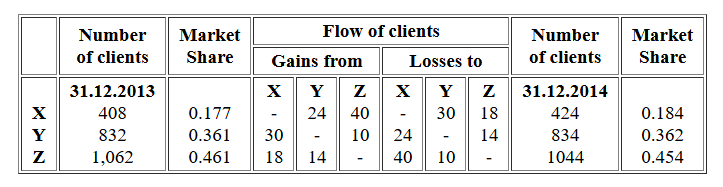
Required:
(i) Convert the above data into a matrix of transition probabilities.
(ii) Estimate each firm's market share for 2015.